|
|
PAHRUMP'S SECRET SANCTUARY FOR TIGERS
KARL AND KAYLA MITCHELL'S BIG CATS
Pahrump Life Magazine
By, Michelle Hermann
May 2012
Could there really be tigers right here in Pahrump? Yes, there is a secret garden in Pahrump and it's not called the “Siegfried and Roy” secret gardens. The land is considered sacred ground by local Pahrump residents and owners, Karl and Kayla Mitchell. They both agreed to sit down for an interview with Pahrump Life Magazine to bring even more attention to these tigers and their needs as well as the many other needs of the other homeless pets they have on their property or currently fostering.
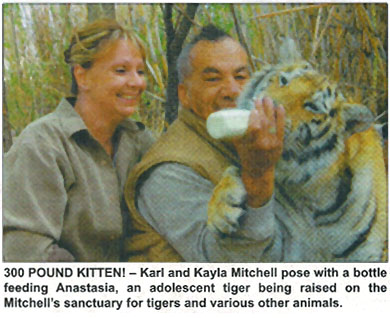 The Mitchell's run a non-profit no-kill facility for any animal that is in peril, regardless of their breed or genetic make-up, called Big Cat Encounters. Big Cat Encounters was first started and founded by Karl Mitchell. This non-profit, no-kill facility was started as a way of bringing much-needed attention to the very real possibility of tigers becoming extinct, which is something Mitchell does not ever want to see happen in his lifetime. The Mitchell's run a non-profit no-kill facility for any animal that is in peril, regardless of their breed or genetic make-up, called Big Cat Encounters. Big Cat Encounters was first started and founded by Karl Mitchell. This non-profit, no-kill facility was started as a way of bringing much-needed attention to the very real possibility of tigers becoming extinct, which is something Mitchell does not ever want to see happen in his lifetime.
What makes it even more fascinating to be on this property are the tigers roaming around in their runs on the back of the property. This sanctuary is located on 20 acres of land, and nestled in a part of Pahrump just below the beautiful mountains. Most people would never be able to find the property unless they know Karl Mitchell personally and he has given them directions and permission to enter his home. And, as Mitchell explained, “I prefer it that way. It keeps the gawkers out.” Mitchell also stated he prefers it this way because of his tigers. He prefers the quiet, natural setting he has created for these big cats.
As on walks onto the property, they will see signs of coyotes and other wildlife that wander on and off the property. There is a mixture of animals that roam the property as well as the natural wild animals that come through the property, such as coyotes, falcons and other wildlife.
Mitchell's hope is, by bringing more education to the public about these animals, it will help to lengthen their life span. With his experience in working with wild animals for documentaries and movies, Mitchell became aware, almost immediately, of the needs of the tiger, an animal Mitchell is very comfortable being around. When watching Karl working with a tiger, it is easy to see the love and admiration but more importantly, the respect Karl has for the tigers.
Mitchell first learned to train and work with animals with the help of his cat, Mitten. Mitchell had trained Mitten to ride on the handle-bars of his motorcycle. After a while, Mitchell thought it would be nice t learn to work with and train other animals. However, living in Hollywood is one thing, getting someone's attention is quite another. So, he devised a plan. He rode around the parking lot at Universal Studio's all day long, in the hopes of meeting and introducing himself to world-renowned animal trainer, Ray Berwick. After a few days of doing this, Mitchell did finally get Berwick's attention. And, just as he had planned, Mitten was right there, on the handle-bars along for the ride. After meeting Berwick and showing him what Mitten could do, Berwick was suddenly very interested in getting to know Karl. That was the start of a very long, professional relationship and mentor ship that would last for almost 20 years. This relationship grew to include a variety of film, documentary and television appearances by animals that have been trained by Mitchell. This led Mitchell to raising and training tigers on his private property.
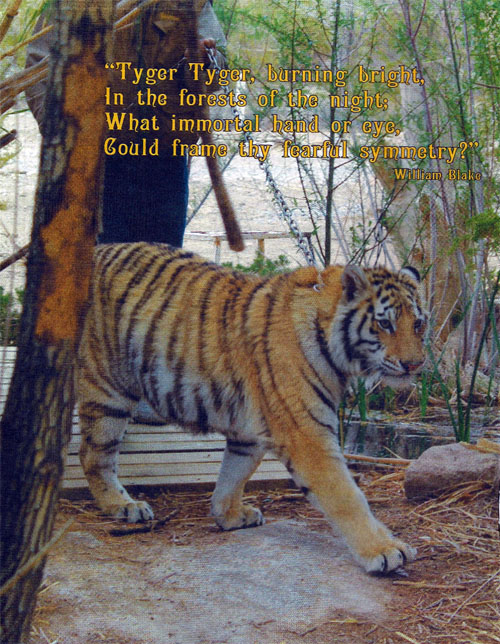 As Mitchell explained, “It is true how an animal can have a healthy, positive and beneficial effect on a person and the healing they can provide to those suffering from a variety of illnesses or disease, simply through a touch or a soft pet on the tiger's head.” Mitchell can speak to this first hand as he has had bouts with severe Post Traumatic Stress Disorder after he returned from Vietnam and subsequently left the military for the civilian world. After a few years in Hollywood, working with animals for a variety of television and film roles, Mitchell soon discovered he was more calm and relaxed when he was surrounded by these big, majestic creatures. “As long as I was around animals, and even more so with the tigers, I had no troubles. They seem to have a calming effect on me.” Mitchell stated. As Mitchell explained, “It is true how an animal can have a healthy, positive and beneficial effect on a person and the healing they can provide to those suffering from a variety of illnesses or disease, simply through a touch or a soft pet on the tiger's head.” Mitchell can speak to this first hand as he has had bouts with severe Post Traumatic Stress Disorder after he returned from Vietnam and subsequently left the military for the civilian world. After a few years in Hollywood, working with animals for a variety of television and film roles, Mitchell soon discovered he was more calm and relaxed when he was surrounded by these big, majestic creatures. “As long as I was around animals, and even more so with the tigers, I had no troubles. They seem to have a calming effect on me.” Mitchell stated.
After the tigers were listed on the endangered species list in the late 1970's, Karl Mitchell decided at that time, he needed to do something to bring more attention and education to the public about the plight of the tiger. Mitchell had dedicated his entire life to quelling the rumors and providing a better education about these creatures of the wild. Through his work with films, documentaries and Animal Planet, a little at a time, Mitchell is bringing much-needed awareness to the very real danger tigers face with extinction. In fact, one of the lions Mitchell has had experience working with and training can be seen in the Logo for the Metro Goldwyn Myers Studios growling and roaring, prior to the film credits running. The most recent appearance of one of Mitchell's tigers in a film or documentary was Animal Planet's own, “Fatal Attraction” series which highlights the needs of tigers and the rate of extinction that tigers are being faced with every day. Most of this, as Mitchell stated, simply comes from not being educated about tigers. The animal, regardless of their make-up and depending largely on how they are treated from birth, can provide a safe, loving and healing experience that words cannot describe unless you have “been there.”
The Mitchell's share their entire property with these majestic creatures. This is no small feat considering the average size of a full grown, adult tiger can reach up to 500 pounds or more. This creates a challenge when it comes to providing food for the tigers as well as the other animals the Mitchell's care for. At times, it can be quite challenging to afford to feed every animal on the property. But, somehow, the Mitchell's always find a way. This, according to Karl, can easily add up in the money department. The average tiger can consume between 15-20 pounds of chicken and beef per feeding. “Obviously, this takes a great amount of commitment and dedication to these animals.” Karl stated. When the baby tigers are born, they are kept in the house, in a bassinet while they are being raised and bottle fed. After they reach about three months of age, Karl will begin working with them and training them. His wife, Kayla is also learning and helping to train the tigers. Something she said, she truly enjoys every moment.
The Mitchell's have nine tigers the property, including their latest arrival, Annastazia, who was born in April 2011. Annastazia was named after Karl's wife, Kayla. She is almost a year old and is already over 300 pounds. Annastazia is bigger than life and yet, she is still playful as a kitten. However, the Mitchell's are keenly aware of the inherent natural instincts that are bred into these animals and the obvious dangers that come with being around a wild animal. And still the Mitchell's treat her with the same respect and dedication as they do with all their animals, regardless of their size. And, when watching Karl and Kayla work with Annastazia, it is clear they both have an incredible love and devotion to their tigers. Although the tigers are always in constant training, the Mitchell's make sure the training is still fun for the tigers.
As the interview continued with the Mitchell's, Karl pulled out a scrapbook that he's kept with lots of pictures of his many, many tigers and cats he's worked with and trained throughout his professional and personal lifetime. The scrapbook is filled with a myriad of photos of various tigers, leopards, lions and even some snakes. But, the very first page Karl opened up in the scrapbook is the picture of Mitten, riding on his motorcycle. A constant reminder to Karl of how he got started doing what he loves to do. “I loved that cat. He gave me my break in Hollywood. Mitten was even in a few television shows, such as Laverne and Shirley and a lot of others,” Karl stated. As the Mitchell's walked around the property showing me different areas where they work with the tigers, Karl showed a place on his property that he calls, “My favorite part of this property.” This little piece of property he was referring to is an area that is surrounded by bamboo with a place to sit down and just relax and calm down. In addition, as you walk through the small opening into the bamboo area, there is a small pond. As Karl explained, “This is where I come to meditate and this is where I bring the tigers to play and cool off, especially in the summer time. They really enjoy this part of the property.” As he explains this, it is clear by Karl's eyes, that he's happy with what he's doing right now. And, it's clear these animals bring him such incredible joy.
As the photo shoot began, Karl brought Annastazia to the bamboo garden and sat her up on a training table, he then asked Kayla to get behind him. Together, with Annastazia, they make a beautiful trio in the photos.
Mitchell's wife, Kayla, also helps to train and assist the animals. Although, Kayla will admit right away that she really didn't know anything about the tiger, other than, “I always wanted to have one.” She is eager to learn anything and everything about them. Kayla had been working at Walmart, here in Pahrump when she, “Heard about this guys who had tigers on his property.” She continued to explain that from then on, she wanted to meet this guy and hopefully have the opportunity to go and “Just pet one of the tigers. That's all I wanted to do. I just wanted to pet one.”
After the sudden death of her fiance, Kayla said she went into somewhat of a deep depression. Kayla said she wanted to come and “just pet a tiger” on the anniversary of her fiance's death because she said she didn't want that date to be a negative or bad memory anymore. She made arrangements with Karl to meet him on his property and “I just never left. I've been here ever since.” Kayla continued, “I'm living my dream. I met and fell in love with the man of my dreams and I keep pinching myself.” Together, they both agree they have found, “Something that had missing in our lives.” Karl continued, “It's just been a great experience for her and for me.” Kayla stated after she touched the tiger and got to bottle feed it, her depression, anxiety and sadness all went away in that one moment. “It was like nothing I've ever experienced before in my lifetime.” Kayla said. She continued to explain that by touching the tiger and looking into his eyes and just sitting with the tiger, she had this overwhelming peace wash over her. Kayla continued, “I can't explain it. But when I look into his eyes, I just knew something had changed within me. Something was all of the sudden, very different. It was like I knew I had this amazing peace. The sadness was completely gone.”
Karl said he does make exceptions for visitors with his tigers if he hears of someone who is having some sort of issue. He stated that if he thinks, by touching a tiger, it could be beneficial or help in some way, he will readily agree and make arrangements to allow that visit to happen. But those are very rare cases. “This is done more to protect the tigers more than anything else.” Karl stated. Mitchell continued to explain there are great benefits to being able to look into the tiger's eyes and see there is something there. Mitchell, who was speaking from his own experience, working with these creatures, has found a true kinship to tigers. After all, the tiger, much like anything else in the wild, is a natural born predator, designed by nature to seek out and prey on their food.
Both Karl and Kayla Mitchell explained there are no words, really, to explain it other than there is this “Energy when you look in their eyes,” Kayla stated. One of the more recent exceptions the Mitchell's made was for a young boy who was doing a school project and research report on tigers. The Mitchell's were contacted by the child's mother to see if it would be possible to have the child come and visit and ask some questions about the tigers and their history for his school project. The Mitchell's agreed to do it for him. When the young boy arrived at the property, Kayla soon noticed how quiet and reserved the young man was, “I noticed right away he wasn't talking. He was just real quiet,” Kayla stated. She continued, “I went up and asked him if he was okay. He told me he was fine. But, I just knew he was not telling me something. So, Karl and I both decided to ask his mother about it.” As the interview went on with the child, both Kayla and Karl began to notice this young man had done his homework on tigers. According to Kayla, “He even knew some things that Karl and I didn't even know about tigers. So everybody got a little lesson that day.”
The Mitchell's later learned from his mother that in addition to having a rare form of Autism, the child was being bullied in school and had attempted suicide. However, after visiting with the Mitchell's and sitting with the tiger and petting it, the child had a remarkable turn-around, not only in school, but in general was well. “Suddenly, he wasn't as reserved and was doing much better in school,” Kayla stated. The Mitchell's could see the ability for this child to have the opportunity to write about and research the tigers but to be able to come and physically touch one, was more than enough for this young man to have a complete change of his attitude on life. Now, according to Kayla, “Because he was allowed to touch a tiger.”
Karl will readily tell people that, “There are hates in the world,” and he has had his fair share of dealing with them. However, there are also good people in the world that truly understand what he is trying to accomplish with his no-kill sanctuary and educational website that is dedicated to tigers. According to Karl, “I've just learned to tune them out. Those types of people have no idea what I'm trying to do. What we are all trying to.” Because Mitchell's sanctuary is non-profit, they still struggle just as much as any other rescue for money to keep the sanctuary running. According to Mitchell, “We are a work in progress. The facility is always evolving and growing.”
PAHRUMP VALLEY TIMES
LOCAL CANINE STARS IN SUMMER COMEDY
September 7, 2012
By Vern Hee
Karl Mitchell and his wife Kayla are co-owners of Big Cat Encounters, an animal rescue located on a remote 20 acres here. The facility is non-profit and a no-kill sanctuary for any animal in need.
Karl Mitchell is also known for training animals and received a little more notoriety when Cheyenne, a canine protege, made it to the big screen.
Karl has an extensive background in animal training. He retired from working for Hollywood but recently had a request from friends still in the business t briefly come out 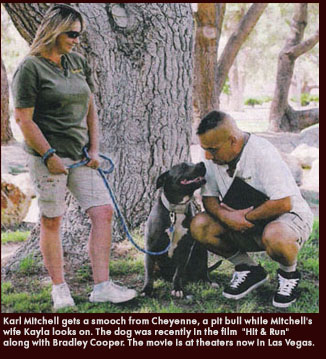 of retirement to assist on the hit comedy “Hit & Run.” The film debuted over the summer in Las Vegas and stars actors Kristen Bell and Bradley Cooper on a hilarious road trip. of retirement to assist on the hit comedy “Hit & Run.” The film debuted over the summer in Las Vegas and stars actors Kristen Bell and Bradley Cooper on a hilarious road trip.
Mitchell said, “I learned how to train animals from an apprenticeship with a man at Universal Studios. I use a positive reinforcement training method. You take the instinctive behavior of the dog and modify it for cue.”
The production company filming the movie needed a well-trained dog, a pit bull to be exact, to orchestrate a complicated scene with actor Cooper in a fight scene. After several dogs were tried, the production company called Mitchell and Cheyenne.
Mitchell said Cheyenne is not a movie dog, in fact this was her first time ever in any production. “Cheyenne was going to be put down. We have a rescue where we rescue animals of all shapes or sizes. Johnny (Bushko) grabbed her out of the shelter. She has been living as a house dog and because we worked occasionally on movies she got this.” said Karl.
Usually Cheyenne stays at home with her owner, Bushko, a caretaker who helps the Mitchell's with the rescue. “Cheyenne loves to swim and is really loving around Johnny's family. She is just a normal house dog that loves to hang out with the family,” said Kayla.
Cheyenne was rescued from a family with more than one dog. Bushko said the owners were not taking care of the animals. “The husband and wife said to each other, If I have to get rid of my dog, you have to get rid of your dog.”
“It was two female dogs trying to assert their territories in the house. I talked to Karl and we got the dog,” said Bushko.
The movie, shot over a year ago in Los Angeles, just recently debuted in local theaters in Las Vegas. The scene required the dog to do some pretty difficult tasks. Normally it takes a good two weeks to prep an animal for an extended scene. Mitchell said it only took a couple of days preparation.
 “The director tried shooting this scene with a Hollywood dog and was unsuccessful. They brought in other dogs too, but again were unsuccessful. In the movie scene the thing we had to have her do was to stay. It was hard because there is a fight going on in the scene and so we had to be in there with her,” Karl said. “The director tried shooting this scene with a Hollywood dog and was unsuccessful. They brought in other dogs too, but again were unsuccessful. In the movie scene the thing we had to have her do was to stay. It was hard because there is a fight going on in the scene and so we had to be in there with her,” Karl said.
Cheyenne is pretty timid. In the movie scene, Cooper, plays a dog lover and when he see the dog tied up in front of the store he loses it.
Mitchell said, “In the movie, we used food rewards and praise to get her to do the scene. The scene is pretty difficult. Cooper beats the guy up for tying up his own dog. The guy is being dragged around and there is blood leaking on the ground. The dog is supposed to be watching the action and then walk slowly to lick the blood off its owner, stop and walk slowly and lick more blood.”
He said it was a fairly long shooting sequence. “We used sugar water and bologna in the fake blood. The dog is as sweet as can be. She just plays an aggressive dog in the movie,” said Karl.
Cheyenne did the shoot in record time. Bushko said,”Cheyenne did it in one take and got a standing ovation.” Karl added, “The crew had already seen some crappy dogs and thought they were in for another day of shooting with bad dogs.”
Show business must be in her blood. Cheyenne did her scenes like a real pro.
Karl also said the ending scene where Cheyenne had to run and jump into Cooper's car was on take, too.
Karl said he only gets those jobs once in awhile now that he is retired.
“She will probably do other films,” said Karl. For now, she is just relaxing, swimming in the family pool and drinking doggy Mai Tai's until the next gig.”
Trainer teaches animals how to act naturally
By Joan Whitely
Review-Journal
The menagerie at Karl Mitchell's Pahrump home is extensive.
There's a kangaroo, chindo dogs from Korea, a lion, tigers, two ligers -- born of a lion father and tiger mother -- horses and ponies, miscellaneous cats and other dogs. And a lot of nervous chickens.
When any of the big cats is about -- out of its cage, on a line held by Mitchell, who is an animal trainer -- the uncooped chickens know to scurry.
As Mustapha, a 2-year-old tiger, lolls on a grassy patch with Mitchell, a clutch of chickens peers intently at the striped predator through a stand of thick underbrush. Mitchell's 10-acre property is fenced, and marked with No Trespassing signs.
Mustapha keeps craning his neck, trying to get closer to the chickens. Mitchell soothes the cat, making the "foof, foof" sound he says is characteristic of tiger language.
It's good practice for Mustapha to be around the chickens, yet gently and persistently directed to ignore them.
"It's to override his pouncing instinct," Mitchell explains. It helps prepare the tiger to remain calm before a live audience.
After all, to the animal, there isn't much difference between a large crowd of chickens and an assembly of primary-school pupils, which Mitchell describes as "300 little chickens all sitting out there, cheep, cheep, cheeping, `Ooh, ah. Look at the tiger.' "
Mitchell, the menagerie and seven employees in two states make up his company, All Acting Animals, which provides both domesticated and exotic animals for use in film and theater projects.
"I could be a charity (nonprofit organization) tomorrow," begins Mitchell, sensitive to criticism from animal lovers that he uses his animals for commercial projects. He also is eager to point out he does wildlife education programs, too.
Some of his recent business deals include providing and handling a tortoise for an AT&T commercial shot at Valley of Fire State Park, an anteater for a CITGO commercial, a butterfly for a Summerlin ad campaign and a falcon for a Falcon Homes billboard.
Mitchell came to Las Vegas in 1982, after writers' and producers' strikes in Hollywood dried up his work opportunities. His first job here was to handle a lion for a cameo role in "Jubilee!"
When the curtains at the former MGM Grand opened to show a large MGM Studios logo, Mitchell's borrowed lion had to roar through an opening in the hanging logo.
Spectators never knew that the lion was "sitting in a large cage on a forklift," with Mitchell to his side, giving cues.
Nor did they realize those swift seconds in the limelight were the apex of a nine-hour work shift for Mitchell.
It took that long to transfer the animal to and from its owner's home, safely get it in and out of the hotel, do a three-hour warm-up and feeding before showtime, and then perform in two shows.
He next left Las Vegas to take overseas jobs involving animals -- in a Venezuelan circus and then in a Korean-made movie -- but returned in 1987, moving to Pahrump.
"It was affordable," Mitchell, 44, begins. Then he ticks off several more advantages. The neighborhood's tranquil rural character means his animals won't get spooked by urban sounds such as sirens and police helicopters. There are fewer idle curiosity-seekers than in the city. And there's a dry lake bed nearby, where he regularly runs his big cats off-leash.
"It's easy to see people from a distance" on a dry lake bed, is how Mitchell explains why the off-leash situation has caused no problems. The animals usually run for about 10 minutes, then want to just lounge near him, Mitchell says. Cars that arrive after he does tend to just circle awhile, and then drive off.
But his presence in Southern Nevada has created some controversy. A couple of years ago, Mitchell received negative television coverage, which he traces to the professional jealousy of "competitors and ex-wives who want to be competitors trying to do damage to a good name."
The 1996 TV coverage reported unclean animal conditions at Mitchell's Pahrump ranch.
"They really demonized me," says Mitchell.
The ranch conditions -- which included accumulation of trash and resulting flies -- led to citations by the U.S. Department of Agriculture but were swiftly corrected.
Mitchell says he was on the road at the time the citations were made. The employees who are custodians in his absence have since been retrained to be "as fastidious as I am," Mitchell says.
His attorney, Robert Glennen, has sent letters admonishing KLAS-TV, Channel 8, and Jonathan Kraft of Keepers of the Wild, a local sanctuary for exotic animals, not to make inaccurate statements about Mitchell. Mitchell also is engaged in litigation against his ex-wife Kari Bagnall.
In addition, Glennen has filed a breach of contract claim against boxer Mike Tyson, who severed a business relationship with Mitchell after the negative publicity.
Mitchell got his career start with a humble pet. Ray Berwick, a now deceased Hollywood animal trainer, wrote in his 1985 "How to Train Your Housecat" book: "Teaching your cat a really unusual behavior can be a ticket to animal-training success, as my friend Karl Mitchell proved with his remarkable cat.
"The first time I saw his cat, I was headed for the parking area on the upper lot at Universal Studios. A motorcycle roared by me up the hill with the rider hunched over against the wind. Between the handlebars in front of him was a small black cat. (Its) ears were flattened against his head and he leaned skillfully with the turns."
Not long after, Berwick hired Mitchell as a trainer at Universal Studios and, the trainer wrote in his book, "within two months Mitten (the pet cat) was a first-rate actor."
Mitchell's break at Universal Studios came in 1976. He started, Mitchell admits, as a "poop and scoop," but worked his way up until leaving in 1981. He still considers Berwick his mentor and model.
"The old-school method of aggression and force" is passé, Mitchell explains. Berwick helped refine Mitchell's intuitive sense that trainers should work within an animal's instincts and natural behavior whenever possible.
Reclining on the patch of shady grass with Mustapha, Mitchell demonstrates. He lets the 350-pound tiger follow through on an urge to roll Mitchell onto his back, then place a hefty paw across Mitchell's stomach.
"By allowing him to do this, it's allowing him to establish his dominance. ... I can't always be calling the shots. I let him call the little ones," which leads to cooperation on the critical points, Mitchell explains. Eventually, Mustapha rolls over, too, and Mitchell regains his sitting position.
"If I don't hit them with sticks, ... I don't antagonize them -- I can get them to do all this stuff," Mitchell says.
Handling animals that must interact with actors in front of bright lights and busy crews is an even higher challenge. The first key is to allow an animal to get accustomed to the environment before asking it to perform the required behavior.
"You just hold them," says Mitchell, referring to one commercial he helped make for AT&T, which required the presence of several lizards. "You let them get calm ... instead of pulling them out of a bag and boom," they have to immediately perform.
Then, the trainer must size up the personality of the actors or crew members who will come in close contact.
Mitchell provided the cat that serves as the pet of a character played by Talia Shire in the upcoming thriller, "Lurid Innocence," with Dennis Hopper.
"You see how her (Shire's) temperament is, and you can tell about the approach (for coaching the cat). You need to see whether you can put some cat food on her face," to induce the cat to lick at the right moment.
Once Mitchell had to tell a director to get a different makeup technician, because the original one was too fearful to get near one of his jungle cats.
Before a new handler can safely handle a cat alone, it takes at least two years of daily contact, for several hours at a time. "It's where and how to stand. How to approach. How to anticipate the (animal's) body language," says Mitchell, whose girlfriend, Susan Vidor, is currently training as his apprentice.
The animals, too, need the consistency that comes from regular handling by only a few trainers.
Right by the front door, sunning itself in a small cage in Mitchell's front yard, sits a young female tiger, Diva. That's not her permanent lodging, but a training cage.
"It's so she can be acquainted with the horse (in a nearby corral). There's people coming, people going." Exposure to visitors, while safe in a familiar cage, allows the tiger to develop self-confidence, Mitchell maintains.
He shows visitors around the rest of the property. One bedroom has been converted into a nursery for Grace, a 6-month-old tiger cub. To learn peaceful coexistence, Grace spends much of her time with a friendly mutt named Peanut.
The room has vinyl flooring covered with sawdust. A picture window has been set into the wall separating the bedroom from the living room, so Mitchell can easily check up on the pair.
Out back are the individual cages that serve as permanent housing for the big cats. The walls are 8 to 10 feet tall. Each cage is 20 by 40, Mitchell notes.
Cage floors are dirt, covered with straw. "It's a more natural way than if they have to be on concrete, as is the case with those sanctuaries," says Mitchell. Concrete is "for the convenience of the keeper, not the animal."
|