


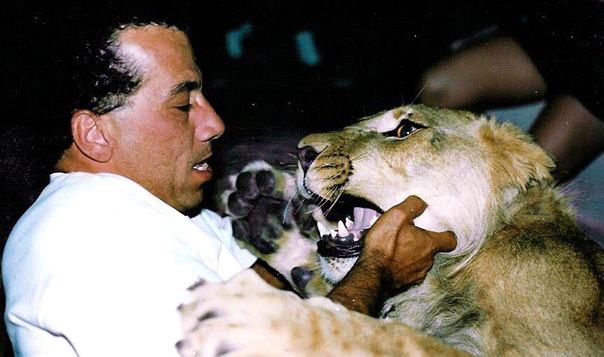
A Recognized Expert
Karl Mitchell, is a world renowned animal expert. For 20 years, he has trained and provided domestic and exotic animals for movies, commercials, rock videos and fashion photography. Your contact with trained "movie star" tigers, ligers and lions will provide you with an experience of a lifetime.
A true animal lover, Karl invites you to share an afternoon with him and his very special children. Come and meet the rare tigers, both white and tabby hetrozigous species.
Karl, owner and operator of Big Cat Encounters Ranch, started in the animal world 25 years ago when he trained his house cat to ride on his motorcycle with him. A veteran animal trainer was impressed and invited Karl to help him in his business. Eventually Karl became a sort of animal guru, able to train animals ranging from antelope to zebra. As Gunther Gebel Williams said "he trains whatever shows up." His real passion has become the big cats of Africa and tigers from India.
Dedicated to Preservation
Karl Mitchell is dedicated to the preservation of rare animals. "The tigers are much more rare than the lions," he says," though they are more difficult animal to work with since they are lone individualists, not family- oriented like lions." Tigers are also bigger. A mature lion can weigh 500 pounds, but a full-grown Bengal tiger can tip the scales at 700 pounds.
Karl does not believe in surrounding his tigers and lions with concrete. His animals are often roaming the fenced-in ranch, and are leashed only when visitors arrive. He trains the animals using love and positive reinforcement, techniques he learned from the trainers he was apprenticed to in Hollywood. He has worked on numerous television shows including Barretta and Emergency. His trained lions and tigers have appeared in many movies, television shows and in photo layouts in such prominent magazines such as Vogue and Elle. Las Vegas convention delegates sometimes see the animals making appearances at various conventions and trade shows on the Strip. The Ranch is often used as a location for international magazine and rock video shoots.
Show business is one thing but Karl Mitchell's long-range goal is to take some of his Nevada-born tigers back to India. "There are 23 wildwife sanctuaries in India cooperating with Project Tiger, a program with
the express goal of repopulating these areas with tigers to make up for those illegally poached before there were parks established," says Mitchell. "I'm contacting them to see what their needs are so that
enventually one of my tigers can grow up in what should be his native land."
What’s in a color? There has been great debate in the world of conservation as to the relevance and appropriateness of different colored tigers. This is even truer when we start looking at white tigers and organizations like the Association of Zoos and Aquariums (AZA). It is important, however, to understand the variety of tiger colors that exist and their suggested origins.
A common theory holds that all tigers once came from Siberia. During the last ice age tigers were forced to migrate south to warmer climates. Tiger territories moved as far south as the island of Bali and as far west as the Caspian Sea. During this great migration, and over many thousands of years, tigers went through varied physiological changes in order to fit into very specific environments. Over time, most tigers became smaller in size; the Balinese tiger was a mere 200 lbs. Another adaptation which occurred amongst the Bengal tiger populations was the occurrence of unique color changes, helping members of this sub-species to adapt to specific ecological niches. Historically tigers are known to have existed in a wide variety of colors. In 1773, artist James Forbes painted a water-color of melansistic black tiger that was killed near Kerala, India.
The most recent verified sighting of a black tiger occurred in 1993, when a young boy shot a female black tiger with a bow and arrow just west of the Similipal Tiger Reserve near the village of Podagad, India. Tiger colors have also been reported to be chocolate, gray and even marbled.
Today four separate colors of the tiger still remain: 1. Standard (orange and black), 2. Royal White (white with black stripes), 3. Golden Tabby (red to pale orange cream stripes and saddle), 4. Show (all white or with ghost strips). All of these varieties of the tiger once occurred in the wild.
Currently tigers are severely endangered. The tiger population has experienced a drastic decline, particularly in the past couple hundred years. The fate of the tiger was heavily shaped by the expansion of the human population and the refinement and widespread distribution of firearms. Today, less than one percent of the original tiger population still exists. In losing the vast majority of the tiger population, we have also lost much of the biological variety that once naturally existed.
Today, as the future of the tiger seems to be in captive hands, there have been great differences of opinion as to the importance and relevance of different colored tigers, white tigers being at the forefront. While the AZA (the largest and most well known zoological organization) is often associated with the dismissal of white tigers as worthy of preservation, this is by no means an institutional wide policy or practice.. Many of AZA’s biggest members are displaying or have displayed, white tigers as a prominent part of their exhibits. These members include San Diego Zoo, Los Angeles Zoo, San Francisco Zoo, Miami Metro Zoo, Kansas City Zoo, The Smithsonian National Zoological Park, Tampa’s Lowry Park Zoo, Omaha’s Henry Doorly Zoo, Chicago’s Brookfield Zoo, Columbus Zoo, Bush Gardens, Discovery Kingdom, and of course the organization centrally responsible for white tigers in this country, the Cincinnati Zoo.
One of the biggest denouncers of white tigers is Ron Tilson of the Minnesota Zoo. He has stated that from his point of view the breeding of white tigers is “irresponsible, if not reprehensible.” Lee Simmons, former director of Omaha’s Henry Doorly Zoo and long time friend of Ron Tilson says, “Ron is a good friend but he’s a little bit idealistic,” and expresses that he (Lee Simmons) has absolutely no qualms with the breeding of white tigers. The Henry Doorly Zoo has been breeding white tigers since the late 1970s and currently owns three white tigers, all of which are on loan to other zoological parks.
Many zoos rely on the draw and revenue that is generated by animals like the white tiger. When the Kansas City zoo geared up for a marketing campaign revolving around their Asian themed exhibit, the campaign revolved around its star, a white tiger named “Silver.” A gift shop full of stuffed white tiger toys, as Simmons puts it, is what “helps with the light and gas bill.” Supporters of white tigers bring up the fact that white tigers do no harm and they allow zoos to increase their financial bottom line, making other conservation efforts possible.
This last sentiment holds the true importance of the white, the snow and the tabby tigers. The fact that these animals are rare is why people come to see them. Human nature by design draws our attention to the unusual. Whether you are fan or a critic of these tigers, it is hard to deny that they have the ability to draw a crowd. This simple fact has two very important implications for conservation. First, these animals become a calling card for a much broader scope of wildlife conservation. In order to convince someone that we need to save the Sumatran tiger – or even the tiger beetle – you need to get their attention. A white tiger will do that. Second, by coming to see the white tiger, much needed funding becomes available to support the zoo itself and to provide funding for conservation projects that would otherwise not exist.
The whit e tiger – along with the snow and tabby – have become an extremely political issue, and has done so in a society obsessed with making sure that everything said or done is politically correct. This pre-occupation unfortunately diminishes and obscures the fact that, just by existing, these tigers draw attention, providing benefit to their own species, wildlife at large, and all of mankind. These varied colors of tiger no longer exist in the wild and the standard color tiger is following close behind. Just the fact that we can preserve this naturally occurring biological variety for future generations does make the world a more wonderful place.
